“The exaggerated esteem in which my lifework is held makes me very ill at ease. I feel compelled to think of myself as an involuntary swindler.”
Guess who said that?
Albert Einstein.
I hear people talking a lot about having impostor syndrome. Especially writers.
Impostor syndrome is a psychological experience in which a person often doubts their skills, talents or accomplishments and is secretly afraid of being exposed as a fraud, although there is plenty of evidence of their competence.
It’s quite natural to doubt your own ability. Whether we’re brought up to believe in ourselves or whether we’ve lived in an environment where we haven’t felt valued, it’s normal to sometimes think we’re failing.
It happens to authors a lot. At times, achievements are put down to external factors like luck or timing. People say: ‘You were in the right place at the right time.’ That makes us fortunate, not talented.
At others, writers feel frauds because so many other good writers remain unpublished. It follows that, in some way, the rest of us don’t deserve our position.
Then there’s that thing called The Valley of Despair. Have you heard of it? The more we become adept at our craft, the more we realise we don’t know.
I’ve been wondering, dear readers – who feels like an impostor and why? Me, you, all of us? Maybe it’s because we’re afraid of failure and we teeter on the edge of it every time we write a book or venture forth with a new project. Or because we set ourselves such impossibly high standards that we can never reach the pinnacle.
Both things make sense.
Harlan Coben is an American writer who has won an Edgar Award, a Shamus Award, and an Anthony Award. His books have been translated into 46 languages and sold more than 90 million copies. And he has spoken extensively about Impostor Syndrome on Radio 4’s Desert Island Discs.
Coben suggested that only bad writers think they’re really good, and that self-doubt is a normal, ongoing part of the creative process. That’s a writer’s paradox. So those of us who feel like impostors are, in fact, doing ok.
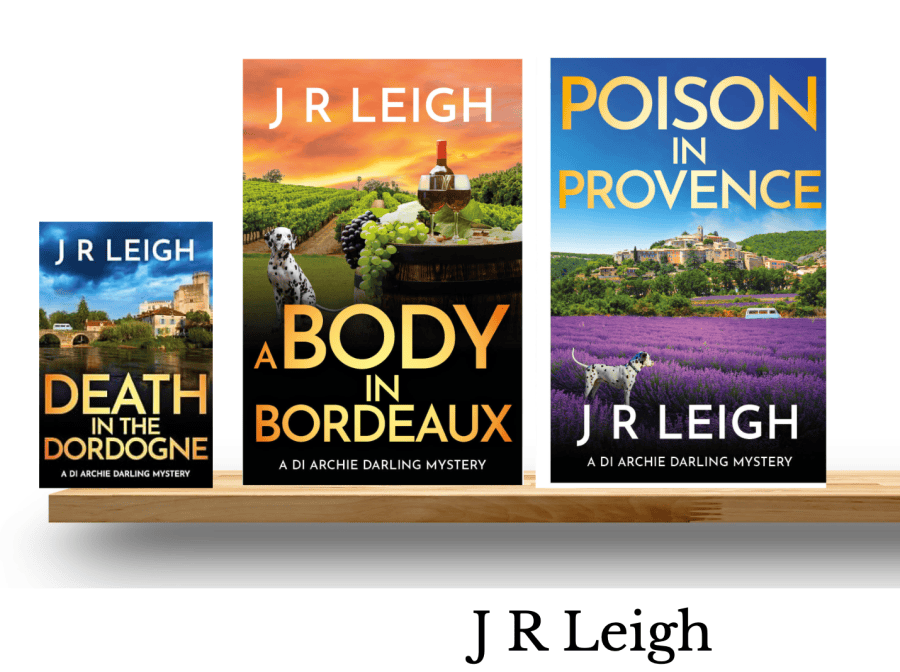
Having written a four-novel cozy crime series, including Death in the Dordogne and A Body in Bordeaux in addition to my current book contract, I’ve had to do a great deal of editing recently. I’d say I’ve had two edits a month at least, and the process is usually great. It’s very therapeutic to rip out all the repetition and rubbish. And believe me, we writers are capable of a fair amount of repetition and rubbish in a 90-thousand-word novel. I’m grateful for kind editors who make me feel like I’m not a total steamer when they kindly go through my mistakes.
But it’s very easy to feel like an impostor at times. In one book, I used an Irish word for badass, meaning kick-ass and tough, only to work out that it really meant malevolent donkey. There was the time I placed the Algarve in Spain and received an editor’s comment, ‘It was in Portugal last time I looked.’
That’s me. Impostor. 100%.
Of course, these mistakes happen because as writers, our minds move fast. I’m on the next sentence, or the next moment of jeopardy, or on the big reveal. Yes, I’ve always known where the Algarve is. But that doesn’t stop that Duuuhhh!! feeling of being a fraud.
Coben also talks about The Paradox of Doubt and Hubris: writers think they are rubbish at their craft while at the same time thinking that readers should spend their time and money on their books.
I’ve talked to writers who, during the process of writing or editing their latest blockbuster, think it’s the worst thing they’ve ever written. They even say they hate it.
That’s normal.
Apparently, people who have impostor syndrome fall into some or all of the following five categories.
- We feel a failure if it’s not perfect.
- We feel like a fraud if we can’t master something immediately.
- We push ourselves hard in every way to compensate or to prove we’re not useless.
- We feel that if we ask for help, we’re incompetent.
- We think we ought to be an expert, and we’re inadequate if we lack knowledge about everything.
Phew! That’s exhausting! Do you recognise yourself in any of those categories?
No wonder we feel like impostors.
Apparently, impostor syndrome is linked with chronic stress, low self-esteem, anxiety, and depression. It is estimated that up to 82% of people experience it at some point in their lives, particularly high achievers.
Does that make ‘impostors’ high achievers?
And how can we deal with this syndrome?
We can talk to others, share our thoughts and feelings. The more of us who admit to the low moments, the more we support each other. We can see our progress as a learning journey and our mistakes as a normal part of growth.
We shouldn’t compare ourselves to others or listen to noise about ourselves or others. We should concentrate on facts.
Many writers find themselves celebrating the publication of a new book and enjoying some truly heartening and well-written reviews. Then someone they don’t know leaves a one-star, without a comment or probably having read the book. Then a second one comes in. The 5.0 rating plummets to 3.8.
From author to impostor in two anonymous clicks.
So – there’s another thing. We should expect negatives and try to ignore them. They’ll pass. And understand that it’s external. It’s not our doing and it’s not our problem.
So, if impostor syndrome is a fear of being found out to be less able than we appear to be, let’s conjure a humorous scenario.
It’s Donald Trump. On Monday morning. He’s doing his hair in front of a mirror and he calls out, ‘Melania – I’m having a moment of self-doubt. What if people realise I’m not up to the job? I’m feeling completely out of my comfort zone. Guess what – I have impostor syndrome.’
Would that ever happen?
There’s something called the Dunning-Kruger Effect, when people with low competence massively overestimate their own skills. Are there people like that?
I won’t venture any further down that snake hole.
Let’s suffice to say that the rest of us can try to be confident, modest, humble about our own work, and to celebrate everyone’s achievements whenever we can, and be supportive and kind.
That has to be the best way forward. What do you think? xx

